
Big Farm Biogas is the New Gold. NSYSU Releases the Annual Observation Report on Carbon Credit Market
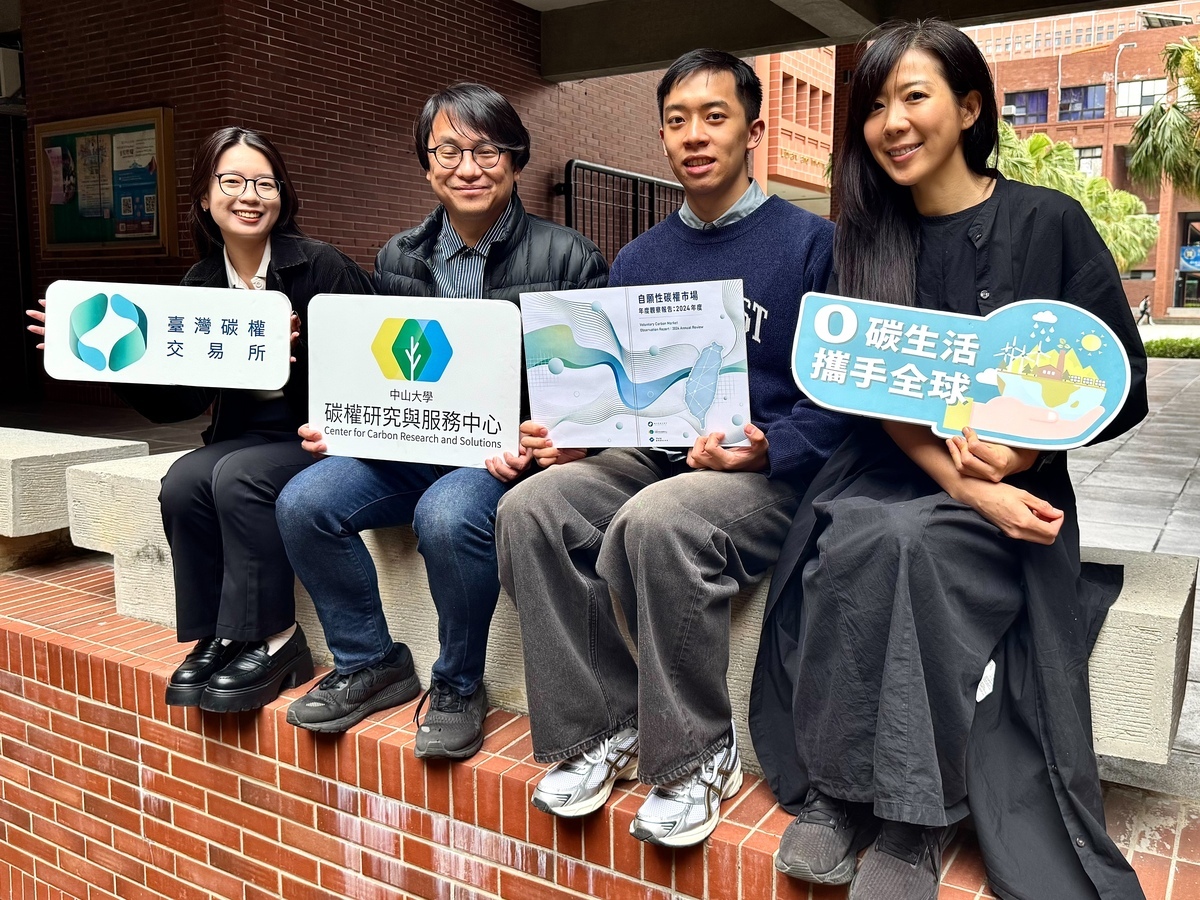
Associate Professor Chien-Yuan Sher from the Business Management Department of National Sun Yat-sen University (2nd from left), guiding graduate students in writing the annual observation report on the voluntary carbon market.
The carbon credit era has arrived. Research shows that biogas collection from pig farms in Taiwan can generate at least 100 million NTD in annual revenue. The Center for Carbon Research and Solution (CCRS) at National Sun Yat-sen University (NSYSU) released the "Voluntary Carbon Market Annual Observation Report: 2024", aiming to disseminate knowledge about carbon credit market, reduce information asymmetry and public skepticism, and ultimately attract more businesses and non-profit organizations to participate in the voluntary carbon market, driving corporate fundings to support greenhouse gas reduction efforts.
The CCRS at NSYSU pointed out that Taiwan urgently needs to accelerate progress to respond to the global wave of carbon pricing policies. Since the passage of the Climate Change Response Act in 2021, the domestic voluntary carbon credit market framework has been implemented, including mechanisms for voluntary emissions reduction projects. The mandatory carbon pricing system introduced the carbon fee and cap and trade system, setting the official price at 300 NTD per metric ton of CO₂e, and the trading of emission reduction credits officially began in October of 2024. The Annual Observation Report on the Carbon Market utilizes data from the international databases to present an overview of the general trends in the global voluntary carbon credit market in 2024, and highlights the participation of Taiwanese buyers and project developers in the international voluntary carbon credit market.
According to the report, Taiwan already possesses mature technologies relevant to carbon credit development, including various methods for calculating carbon sinks, afforestation, methane capture, replacement of household and industrial equipment, and biochar production. The report further highlights carbon credit project types with high development potential in Taiwan. For instance, in the case of biogas capture projects at pig farms, biogas collection at farms with herd sizes ranging from 20 to 4,000 pigs across Taiwan could result in an annual reduction of 340,000 to 510,000 metric tons of CO₂e. At a rate of 300 NTD per ton of CO₂e, biogas capture projects at pig farms in Taiwan could generate a minimum of over 100 million NTD in annual revenue.
However, the report reveals that whether through Taiwan-based projects participating in the international carbon credit market or the domestic voluntary reduction market, only around 6,080 metric tons of CO₂e of carbon credits were developed locally and verified domestically for listing in 2024, causing Taiwan's participation in supplying carbon credits in the international market has nearly come to a standstill, resulting in a significant gap between supply and demand. The primary reasons are that carbon credit knowledge remains concentrated in the hands of a few, leading to information asymmetry that discourages potential developers. Additionally, the complex administrative procedures and high certification thresholds pose significant barriers to registering carbon credits.
“The original purpose of the voluntary carbon market is to channel corporate funding into projects that benefit the planet, such as forest restoration, rather than relying solely on public goodwill,” said Associate Professor Chien-Yuan Sher from the Department of Business Management at NSYSU, and lead author of the report. However, a series of certification measures is necessary to prevent fraud. For example, in the case of a small pig farm with 1,500 pigs, the annual methane capture could generate 106 metric tons of CO₂e in carbon credits, making 31,800 NTD in revenue. Yet, the costs of equipment and administration such as project proposal and documentation often far exceed this amount. Chien-Yuan Sher emphasized that multiple approaches can be applied to resolve this issue, including government efforts to streamline registration procedures and simplify the verification process; expanding knowledge dissemination to improve public understanding of carbon credit principles, certification procedures, and market information; and referencing international experiences in carbon offset projects. These efforts rely on public sectors, associations or NGOs to coordinate and consolidate registrations on behalf of small-scale farmers, sharing the costs and enabling smaller pig farms to collectively react to high administrative expenses. This approach could lead to the successful implementation of carbon credit projects, generate significant external benefits, and strengthen the carbon reduction capabilities of Taiwan’s livestock industry.
The lead coordinator of the carbon market observation report is Associate Professor Chien-Yuan Sher from the Department of Business Management at NSYSU, who also serves as one of the advisors at the CCRS. The report’s co-authors include graduate students Chu-Ying Chen, Jui Chu, and Pei-Yun Yu. The CCRS, TCX and TWSE recently co-hosted the "2025 Voluntary Carbon Market Observation and Trend Analysis Seminar", in addition to releasing the market observation report, the event provided a platform for communication between various market participants and regulatory authorities. The seminar also featured the sharing of practical experiences related to carbon credit registration and verification, hoping to become a regular initiative to encourage broader participation in Taiwan’s voluntary greenhouse gas reduction efforts.
🔗Article Source:NSYSU NEWS