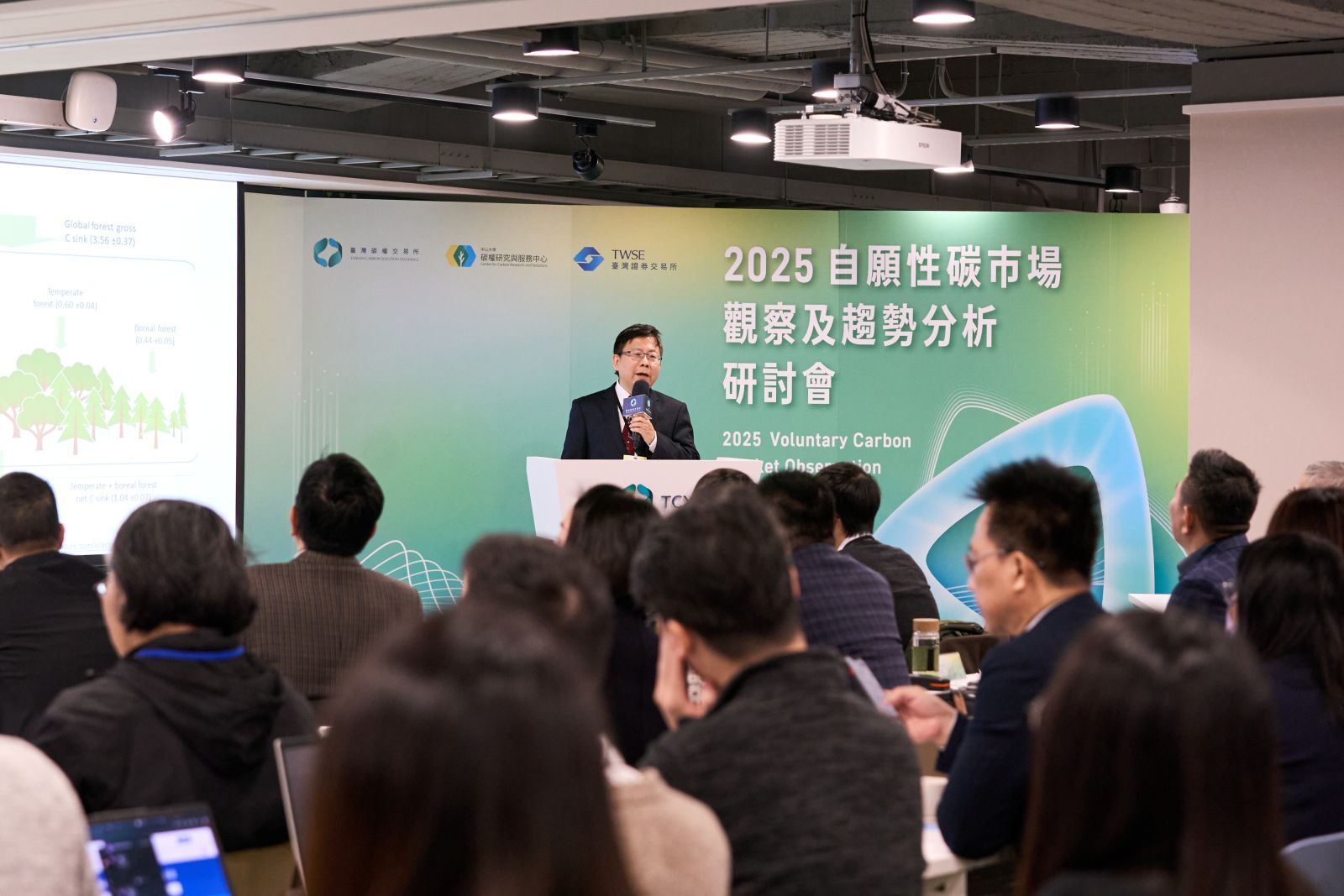
[Seminar Highlights] Secretary General Jiunn-Cheng Lin: The Potential of Forest Carbon Sinks in Taiwan
Achieving net-zero emissions by 2050 has become a publicly announced target for Taiwan. To fulfill the vision, Taiwan is actively formulating diverse carbon pricing policies. The carbon fee system will take effect officially in 2025, accompanying various mechanisms such as the voluntary emission reduction credit and issuance of allowance, aiming to strengthen and accelerate carbon reduction initiatives in Taiwan.
What potential does Taiwan's voluntary emissions reduction credit market currently hold? What options are available for those interested in developing voluntary emission reduction projects? On February 21st, 2025, the Taiwan Carbon Solution Exchange (TCX), Center for Carbon Research and Solution (CCRS) at National Sun Yat-sen University (NSYSU), and the Taiwan Stock Exchange (TWSE) jointly held the "2025 Voluntary Carbon Market Observation and Trend Analysis Seminar". Representatives from academia, industry, and government gathered to explore the current state and future development of voluntary carbon markets.
The second session of the seminar featured industry representatives: Jiunn-Cheng Lin, Researcher at the Forest Management Division of the Taiwan Forestry Research Institute; Ying Chi Hsu, R&D Manager of the Industrial Green Technology Group of the Industrial Technology Research Institute Central Region Campus; Chenwei Huang, General Manager of the Jan Cheng Lighting Co. Ltd. Southern Division. These professionals shared insights into the carbon reduction potential and carbon credit opportunities within their respective fields.
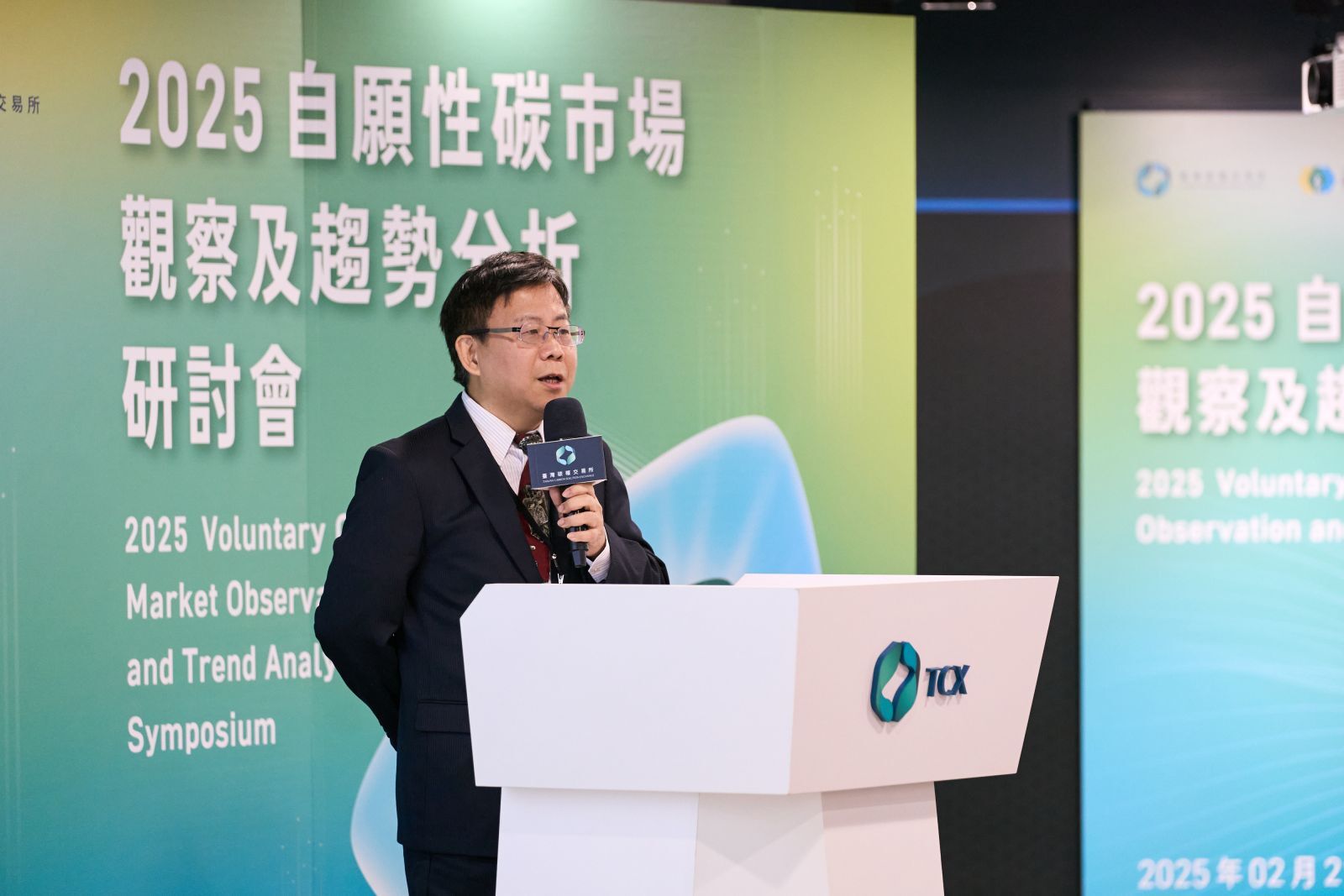
Jiunn-Cheng Lin from the Taiwan Forestry Research Institute said, “Forests also go through birth, aging, illness, and death. Through reasonable management, we can create more opportunities for forest regeneration on existing woodland, thereby enhancing forest carbon sinks.” He emphasized that natural carbon sinks or forest-based carbon sinks are closely connected to nature itself, “climate change affects biodiversity, and the impact on biodiversity also influences climate change.” Therefore, properly utilizing and managing forests to help mitigate climate change is a mutually reinforcing approach.
Among Taiwan’s twelve key strategies for achieving net-zero emissions by 2050, the ninth focuses on natural carbon sinks. Carbon sinks include "natural carbon sinks" and "artificial carbon sinks". Natural carbon sinks encompass forest carbon sinks, blue carbon, and agricultural soil carbon sinks; while artificial carbon sinks refer to engineering technologies such as carbon capture and storage (CCS).
How does Taiwan implement forest carbon sinks?
“If we keep thinking that protecting forests means doing nothing and avoiding any productive plantation forestry, such an approach will prevent us from increasing the self-sufficiency rate of domestic timber and expanding afforestation areas,” said Jiunn-Cheng Lin. He pointed out a common misconception that “owning a lot of forests automatically means possessing carbon credits,” which is in fact not entirely accurate.
“In fact, carbon sinks and carbon credit trading require what we call "additionality", there must be some extra performance to make the effort become a carbon credit product.” Taking forests as an example, only afforestation from previously non-forested land or increasing carbon sink volume could be qualified as tradable emission reductions in the market. Although the increase of carbon sequestration from forest management is typically less than afforestation, the land area of managed forests can be much larger. Recently, Taiwan approved a project on "enhanced forest management", Jiunn-Cheng Lin explained, “we manage existing forests better, and in the process, some forest products (i.e. processed wood products) contribute to carbon storage. Harvesting trees can also reinforce the growth of retained trees, and the remaining open space can be used for new afforestation.”
The concept of bamboo forest management is similar. By revitalizing abandoned bamboo groves and managing them sustainably, forest carbon sinks can be increased. Forest farmers then can benefit from the outputs, and proper management also helps reduce the risk of forest fires. This demonstrates that creating forest carbon sinks offers multiple benefits, not just carbon credits for offsetting carbon fees.
Implementing nature-based carbon sinks requires to follow these standards
To obtain emission reduction credits from carbon sinks, it is necessary to meet the requirements of carbon standards. In Taiwan, this involves referencing the Ministry of Environment's voluntary reduction project guidelines; internationally, it requires compliance with independent verification bodies such as the Verified Carbon Standard (VCS) or the Gold Standard. Some countries also have their own designated institutions. For example, if a company sets up a factory in the United States, it may need to purchase carbon credits from the American Carbon Registry (ACR) or the Climate Action Reserve (CAR); if it's in Japan, companies would need to purchase J-Credits (Japan’s carbon offset allowance).
In fact, there aren't many natural carbon sink projects so far, yet they remain highly favored by enterprises. In Taiwan, there are four main types of natural carbon sink methodologies related to forestry: afforestation and reforestation carbon sink projects, enhanced forest management carbon sink projects, bamboo forest management carbon sink projects, and low-biomass forest enhancement projects. Additional methodologies currently under review include: agriculture improvement, soil management, seagrass restoration, and mangrove reforestation.
Moreover, the administrative costs for voluntary greenhouse gas reduction projects remain relatively high in Taiwan, due to the limited number of projects and the requirement for third-party verification. The costs may even exceed the implementation expenses of the project itself. Jiunn-Cheng Lin pointed out that there are several key considerations for developing nature-based carbon sink projects in Taiwan
-
It is necessary to confirm whether the farmland meets eligibility requirements.
-
Currently, there are only two verification and validation bodies in Taiwan, and many project developers are stuck due to limited verification capacity.
-
It is important to ensure the professionality of project implementation. There must be a project proposal and a clear monitoring plan.
-
Growth performance during the crediting period involves uncertainty. Natural processes are not as immediately measurable as replacing boilers or lighting, so risks may be unavoidable.
-
The project evaluation process and administrative procedures can be challenging and may involve significant communication barriers.
This shows that Taiwan’s voluntary carbon reduction market is still far from mature and thriving, and continued collaboration and communication among various stakeholders are needed to overcome the obstacles.