[Seminar Highlights] Christoph Saurenbach: EU CBAM
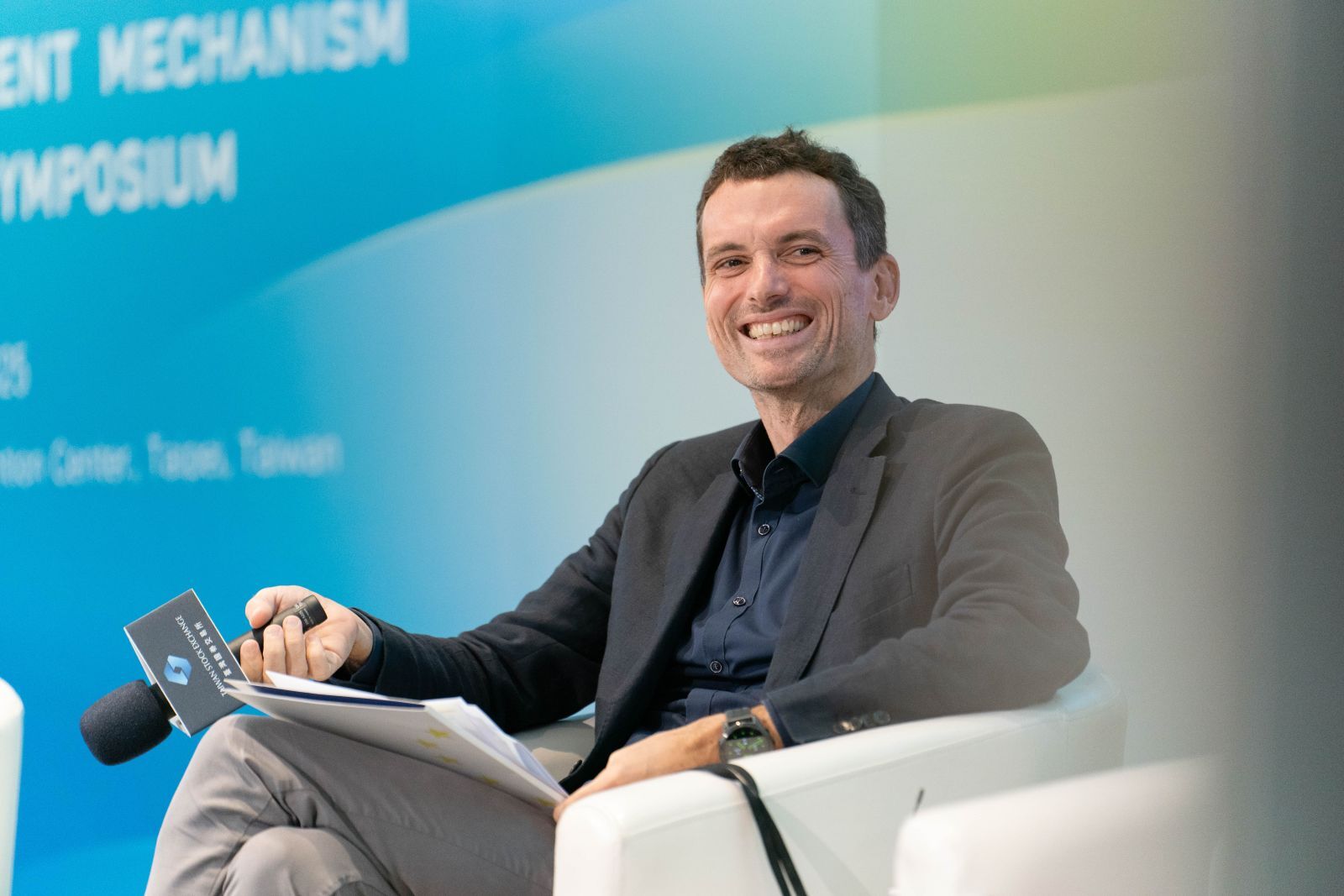
Christoph Saurenbach is the Head of Trade Section of the European Economic and Trade Office in Taiwan.
As the implementation date of the EU Carbon Border Adjustment Mechanism (CBAM) draws nearer, many major trading nations are closely monitoring the situation. How will Taiwan respond to the international developments? On January 17th, 2025, the Taiwan Carbon Solution Exchange (TCX), the Center for Carbon Research and Solution (CCRS) of National Sun Yat-sen University (NSYSU), and the Taiwan Stock Exchange (TWSE) jointly hosted the “2025 Taiwan Carbon Border Adjustment Mechanism Policy Seminar”, inviting representatives from academia, industry, and government to share their insights and advices.
In the session featuring government representatives, Ling-Yi Tsai, Director General of Climate Change Administration under the Ministry of Environment; Huai-Shing Yen, Deputy Trade Representative of Office of Trade Negotiations under Executive Yuan; Christoph Saurenbach, Head of Trade Section of the European Economic and Trade Office in Taiwan; and Je-Liang Liou, Director of the Center for Energy and Environmental Research at the Chung-Hua Institution for Economic Research, each shared their observation and suggestions.

After the EU announced the upcoming implementation of CBAM, many trading countries expressed differing opinions. In response, the EU designed a long period of transition and implementation phases, aiming to provide ample time for understanding and making appropriate adjustments, to ensure that CBAM truly aligns with environmental goals without placing excessive burdens on corporations.
Christoph Saurenbach shared that CBAM is a key component of the EU Green Deal, aiming to achieve climate neutrality by 2050 and a 55% emissions reduction by 2030. Under this framework, European corporations are subject to very strict emission standards, and any excess emissions must be paid for. “We also hope to prevent carbon leakage, where emissions are generated elsewhere and the related products are then imported into the EU, so the CBAM policy was designed to address this issue,” he explained.
EU CBAM aims for fair conducts, not fees
Before the EU actually begins to implement CBAM, high carbon leakage risk products importing to Europe are not required to pay for related fees. However, even when CBAM is implemented (Editor’s note: which may be postponed to 2027 according to the EU’s proposed Omnibus simplification), there will be a 9-year transitional period during which free allowances will be provided and gradually phased out. Christoph Saurenbach emphasized, “products produced domestically and abroad will be treated equally. Any carbon-related costs paid in a third country will be deducted from the final CBAM calculation. Whether a corporation is based in the EU, domestically, or overseas, it will be treated the same.”
Some corporations and trade partners think that the reporting obligations are overly complex, so the EU is currently conducting assessments to make adjustments. Christoph Saurenbach stated, “the EU receives up to 20,000 declarations and reports every quarter, and each must go through very careful reviews and assessments.” However, he also reassured everyone not to be overly concerned. “If Taiwanese corporations export products covered by CBAM to the EU, their responsibility is simply to monitor and collect carbon emission data, and provide it to the declarants, which means the European importers, so they can submit the necessary reports.”
The EU is currently working actively to establish verification and certification bodies, and once CBAM is formally implemented, there will be clear regulations and procedures in place. In the future, CBAM will prioritize the following:
-
Standardize monitoring, reporting, and verification procedures;
-
Support developing and low-developed countries in complying with relevant regulations;
-
Minimize administrative costs as much as possible.
Christoph Saurenbach said, “many trade partners have started adopting mechanisms similar to CBAM, which shows that there is a shared belief that the CBAM policy goals and direction are the right path forward.”
How should corporations prepare for CBAM?
For corporations exporting products to the EU, Christoph Saurenbach reminded them, “your main responsibility is not to read every page of the regulations, because the primary reporting obligation lies with the EU importers. It is the importers’ duty to ensure the necessary fees are paid. The most important obligation for exporters is to maintain close communication with importers and provide them with accurate and timely carbon emission data.”