
[Seminar Highlights] Deputy Minister Wen-Chen Shih: Is CBAM a Fair Trade Mechanism or a Trading Barrier?
On January 17, 2025, the Taiwan Carbon Exchange, the National Sun Yat-sen University Carbon Rights Research and Service Center, and the Taiwan Stock Exchange jointly held the "2025 Taiwan 'Carbon Border Adjustment Mechanism' Policy Seminar," inviting representatives from academia, industry, and government to discuss the challenges and urgency of the carbon border adjustment mechanism, as well as related implementation recommendations.
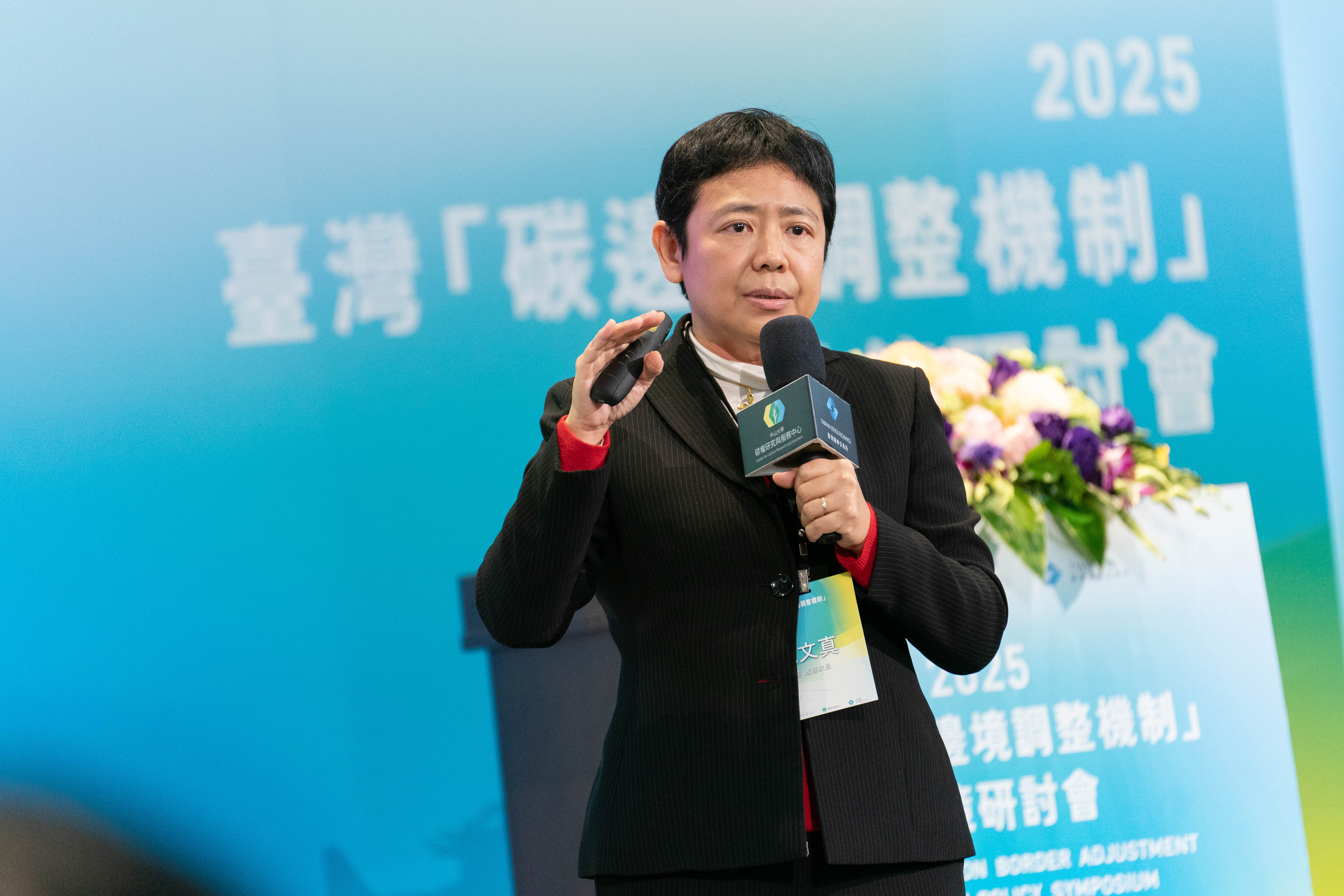
At the beginning of the seminar, Shih Wen-chen, Political Deputy Minister of the Ministry of Environment, in her capacity as a professor in the Department of International Economics and Trade at National Chengchi University, took the lead in explaining the current situation and considerations of the carbon border adjustment mechanism.
What is the CBAM "Carbon Border Adjustment Mechanism"?
Shih Wen-chen pointed out that almost every government policy may require the implementation of a "border adjustment mechanism." "If domestic manufacturers incur additional costs in the production process, we would certainly want imported products to be subject to the same controls. Some controls are for safety reasons, but if they simply increase costs, we will use 'border adjustment' measures, provided that there is such a policy domestically."
As climate change intensifies, carbon reduction has become an issue that governments around the world must face, and industries are also facing carbon reduction responsibilities. In this regard, it is crucial to formulate reasonable and comprehensive corresponding mechanisms for international trade, which has also led to the emergence of the "Carbon Border Adjustment Mechanism."
For example, the "Carbon Border Adjustment Mechanism" (European Carbon Border Adjustment Mechanism, EU CBAM) implemented by the European Union aims to effectively prevent carbon leakage by levying relevant certificate fees on imported carbon-intensive products. During the policy transition period, the initial scope of regulation includes six major industries: steel, cement, fertilizer, aluminum, electricity, and hydrogen, and the items may expand over time. Shih Wen-chen explained that CBAM is a tool to maintain fair competition between domestic and foreign industries, so that imported products bear the same carbon costs as local products. If the country of the taxed entity also implements corresponding "carbon pricing" measures, the corresponding certificate fees can be exempted after being recognized by the European Union.
The carbon border adjustment mechanism will increase the cost of products subject to taxation, thereby promoting companies to reduce carbon emissions in the process of manufacturing products, which is now gradually becoming an international trend.
From EU CBAM to Taiwan's CBAM
For the EU, CBAM is a very important policy tool. It is an important measure in the "Fit for 55" package proposed by the European Commission in 2019 after the publication of the "European Green Deal" to ensure the achievement of the 2030 interim greenhouse gas emission reduction target.
Shih Wen-chen shared the EU's climate legislation process. The EU began implementing cap-and-trade in 2005, initially targeting the aviation industry, which was regulated by the WTO, requiring airlines flying to or from the EU to participate in the cap-and-trade system, but this caused a great backlash due to increased costs.
In the early days, in order to reduce the carbon costs of industries with high carbon leakage risks, the EU set a total carbon emission limit and provided preferential treatment in the form of free allocation. However, this is, after all, a carbon reduction tool. The EU hopes that the total amount will decrease faster and faster until the free quotas are completely cancelled one day, and the overall system returns to cap-and-trade, with the market determining the carbon price.
The President of the European Commission officially announced the carbon border adjustment measures in 2020 and published the draft in 2021. In October 2023, the reporting for the transition period has begun, and it is expected that CBAM certificates will have to be purchased for the carbon content of products imported into the EU in 2026. (Note 1: The European Commission proposed in February 2025 to postpone the purchase of CBAM certificates to full implementation in 2027) 1 However, the EU CBAM also agrees that if the product has already borne the same carbon pricing costs in the exporting country, it can be deducted when it is required to pay carbon fees when entering the EU.
When the EU announced carbon border adjustment measures in 2020, it also affected Taiwan, prompting the amendment of the "Greenhouse Gas Reduction and Management Act" to the "Climate Change Response Act," which also included carbon fee policy tools in order to connect with the EU carbon pricing system and maintain Taiwan's international trade competitiveness.
Shih Wen-chen analyzed: "Nearly a quarter of global emissions are subject to carbon pricing, but this also means that three-quarters are not, and even if carbon prices are implemented, the prices are different in each place. Against this background, it raises the question of whether a Taiwanese version of CBAM is also needed."
The Complexity and Controversy of the Carbon Border Adjustment Mechanism
However, the definition of the carbon fees currently collected by Taiwan on imported goods still needs to be clarified.
Obstacle 1: Carbon Tariff vs. Carbon Fee, Definition Unclear
Shih Wen-chen emphasized: "A carbon tariff represents a charge that is only levied on imported products and is based on the carbon content of the product." Such measures must comply with Article 2 of the GATT (General Agreement on Tariffs and Trade), which means that once the tariff between two countries is negotiated, it cannot be increased arbitrarily, becoming a binding tariff rate.
A carbon fee is a type of border adjustment measure. In order to ensure fair trade, imported products must be subject to it only if there are domestic carbon pricing measures. This is the meaning of Article 3 of the GATT, the "National Treatment Principle." However, the prerequisite is that a carbon fee policy must first be formulated and implemented domestically.
Obstacle 2: How to Classify Carbon Emission Controls? Direct Tax? Indirect Tax?
Cross-border products are divided into direct and indirect taxes in terms of taxation:
- Direct tax: Usually refers to income tax or profit-seeking enterprise income tax
- Indirect tax: Levied on goods and services, transferring the tax burden to the final purchaser or consumer, and is also reflected in the selling price
Border adjustments only allow the collection of indirect taxes, such as energy fuels, which are indirect taxes that can be subject to border adjustments. However, Taiwan's carbon tax is not levied on energy fuels, but on emissions. However, carbon emissions are not directly reflected in the product. Taking steel as an example, the emissions from the steelmaking process are not reflected in the steel product. Even if it is the same steel product, different steelmaking methods will result in different carbon emissions, so carbon emissions cannot be border-adjusted in the same way as raw materials. Therefore, whether carbon emissions can be considered an indirect tax (border adjustment) is still controversial.
However, if carbon fees cannot be subject to border adjustment measures (indirect tax), then they belong to tariffs (border measures), and the regulations are very strict. The definition of tariff or non-tariff also affects the density of legal regulations.
Shih Wen-chen proposed: "Using emissions as the object of charging, will it become a direct tax? This is really uncertain. If it is a direct tax, it cannot be subject to border adjustment; if it is an indirect tax, it can be subject to border adjustment. If border adjustment is possible, you must comply with the national treatment principle and design a sound domestic system that complies with fair trade."
How to define and classify carbon fees depends entirely on the design of the underlying public policy. However, Article 20 of the GATT, "General Exceptions," may be a solution. General exceptions refer to "necessary measures to protect human, animal or plant life or health, or to conserve exhaustible natural resources, which can be justified by public policy exceptions," and are not affected by the above definitions.
Related definitions have not yet been finalized in Taiwan. Finally, Shih Wen-chen emphasized: "When you design a border adjustment system, it actually follows your domestic system, and it is a symbol of fair trade reflection. But if your design today cannot comply with the national treatment principle, it will become a trade barrier. This depends on how our country designs it if it wants to implement a carbon border adjustment mechanism."
1. In the "Omnibus" proposal submitted by the European Commission in February 2025, the EU CBAM plans to postpone the levy of CBAM certificates to 2027 and propose simplified amendments to reduce the administrative burden on SMEs, including: exempting small importers (mainly SMEs and individuals) from obligations, exempting importers with annual imports of less than 50 tons from CBAM reporting obligations, simplifying the authorization of reporters, emission calculations, and reporting compliance requirements. (Simplified and Strengthened CBAM Amendment Proposal)
The European Commission published the "Competitiveness Compass" in January 2025, based on the personal perspective report on Europe's future competitiveness presented by Mario Draghi, former President of the European Central Bank and one of Europe's great economists, commissioned by the Commission. To make the EU economy more prosperous and competitive, it proposed three major measures and five promotion strategies. On February 26, the European Commission proposed two "Omnibus" simplification proposals, hoping to create a better business environment for companies and ensure that companies are not hindered by excessive regulatory burdens. The proposals will now be submitted to the European Parliament and the European Council for review and adoption. The first batch of "Omnibus" brings together proposals from multiple related legislative areas, proposing comprehensive simplifications covering a wide range of areas, including: sustainable finance reporting, sustainable due diligence, the EU sustainable taxonomy, the carbon border adjustment mechanism, and the European investment plan.