
[Think Tank] The Impact and Significance of Carbon Credit and Carbon Fee Offset
On April 29th, 2024, the Ministry of Environment announced a draft regulation for the collection of carbon fees, with plans to begin levying fees in May 2025 based on each enterprise’s greenhouse gas emissions in 2024. The Ministry repeatedly emphasized that the purpose of the carbon fee system is to provide incentives for enterprises to reduce emissions, not to serve as a fiscal tool.
In addition, the draft also stipulates that a portion of the emissions subject to carbon fees may be offset using reduction credits acquired by enterprises (also referred to as voluntary carbon credits or carbon offsets). For credits obtained domestically, such as from "Voluntary Reduction Projects", "Offset Projects", or "Early Action Reduction Credits", the deduction is capped at 10% of the emissions subject to the fee. For credits acquired from abroad, an additional deduction of up to 5% of the fee-liable emissions is allowed if the enterprise is not classified as high risk of carbon leakage.
The following provides a brief analysis from an economic perspective to explain why the carbon fee system can incentivize enterprises to reduce emissions, and what potential effects may arise from allowing voluntary carbon credits or offsets to be used to offset carbon fees.
Why can the imposition of carbon fee drive enterprises to reduce carbon emission?
The carbon fee is based on the “polluter pays” principle outlined in Article 28 of the "Basic Environmental Act". Since greenhouse gas emissions lead to climate change and cause harm to unspecified third parties, emitters should pay for the damage they impose on the environment. Carbon fees can enhance emission reductions through two mechanisms. First, by the force of market supply and demand: when the cost of a product increases due to carbon fees, its price rises accordingly, which leads to a decrease in consumption and, in turn, less production is required and thus reduces the emissions. Second, through manufacturers’ efforts to lower costs: the implementation of carbon fees motivates companies to adopt emission-reducing equipment or production systems to minimize the amount of carbon fees they must pay. To explain the latter more concretely, we can use a simple model.
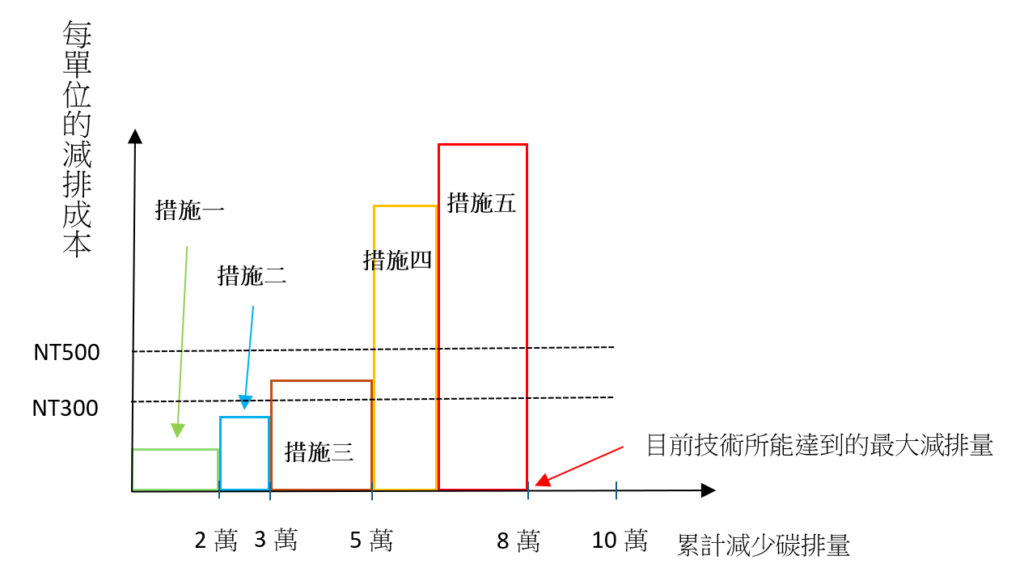
For corporations, different equipment used in the production process may result in varying levels of direct or indirect (i.e. electricity consumption) carbon emissions, and the costs of implementing emission reduction measures for these devices may also differ. Some equipment requires significant investment to achieve emission reductions, for example, replacing a steelmaking blast furnace, while others can be easily upgraded with minimal cost, such as replacing outdated, energy-consuming appliances. Suppose Company A emits 100,000 tons of CO₂e annually, the effectiveness of its various emission reduction measures can be ranked by the cost per ton of CO₂e reduced (hereafter referred to as the "emission reduction cost per unit"), as shown in Figure 1. The "emission reduction cost per unit" for Measures 1 and 2 are below 300 NTD per ton, while Measure 3 falls between 300 and 500 NTD per ton. If all three measures are implemented, the total emission reduction would be 50,000 tons. The total implementation cost can be represented by the area under the bars of the three measures in Figure 1.
(Image Source: Provided by the author
Under a carbon fee of 300 NTD per ton with no free allowance, if Company A does not implement any emission reduction measures, it will be required to pay 30 million NTD in carbon fees. However, if the company adopts Measures 1 and 2, it can reduce emissions by 30,000 tons, lowering its carbon fee payment to 21 million NTD. Adding the cost of implementing Measures 1 and 2 (represented by the area of the first two bars), the total expenditure would be less than 30 million NTD. Since implementing reduction measures is more cost efficient, the 300 NTD carbon fee incentivizes Company A to directly reduce 30,000 tons of emissions. Similarly, if the carbon fee increases to 500 NTD per ton, Company A’s emission reductions could reach 50,000 tons.
In addition, compared to the period before the implementation of the carbon fee system, Company A’s production costs still increase (due to the costs of implementing Measures 1 and 2, plus the 21 million NTD in carbon fees), leading to higher product prices. As a result, production volume is likely to decrease, leading to further decline in carbon emissions. The extent of this reduction depends on the price flexibility of demand for Company A’s products.
The impact of allowing Voluntary Carbon Credits to offset carbon fees on emission reduction
Allowing voluntary carbon credits to offset carbon fees may create a slightly different scenario. Suppose the market price of domestic carbon reduction credits is 200 NTD per ton, as shown in Figure 2, this price is higher than the "emission reduction cost per unit" of Measure 1 for Company A, but lower than Measure 2. Since acquiring carbon reduction credits is cheaper than paying the carbon fee, and assuming the offset ratio is 1:1, Company A would be incentivized to obtain 10,000 tons of domestic reduction credits to offset 10% of its chargeable emissions. For the remaining 90,000 tons of emissions, since the carbon fee rate is still higher than the "emission reduction cost per unit" of Measures 1 and 2, Company A would find it more cost efficient to implement those two measures and then pay the carbon fee for the remaining 60,000 tons (18 million NTD), rather than directly paying the fee for all 90,000 tons (27 million NTD).
In other words, although the market price of domestic carbon reduction credits is lower than the "emission reduction cost per unit" of Measure 2 for Company A, this does not deter the company from implementing Measure 2, because the decision to adopt Measure 2 depends on whether its unit cost is lower than the carbon fee rate, not on the market price of the reduction credits. Establishing a system that allows voluntary carbon credits to offset carbon fees does not change Company A’s direct emission reduction amount, which remains at 30,000 tons. The only difference lies in the form of payment, instead of paying 21 million NTD to the government, the company pays 18 million NTD to the government and 2 million NTD in the voluntary carbon credit market.
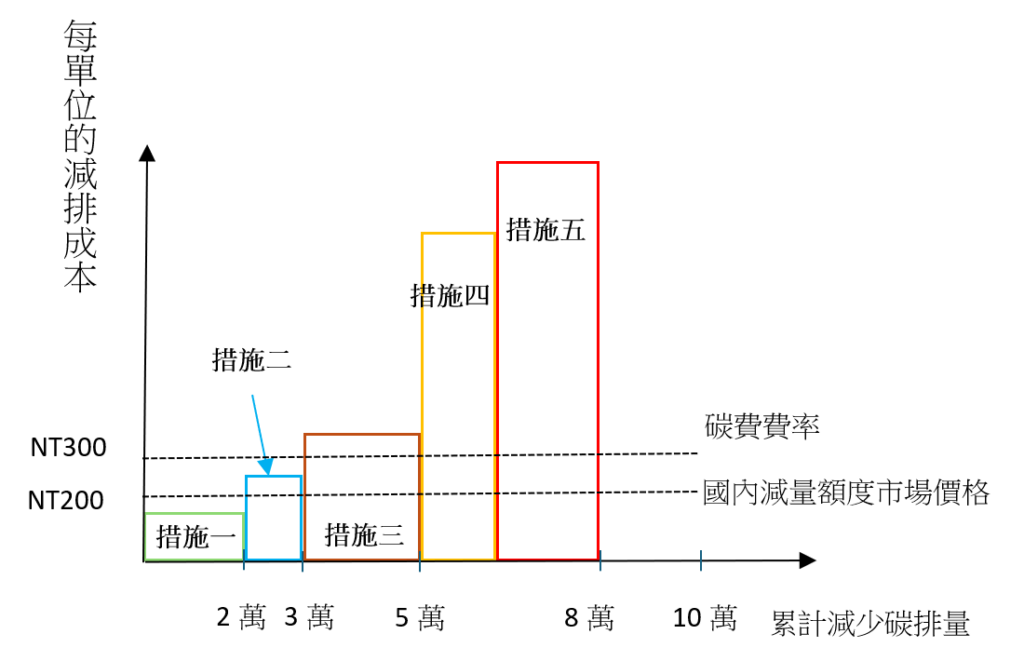
However, compared to a scenario without the carbon credit offset mechanism, the increase in Company A’s total cost would be slightly lower (including the costs of implementing Measures 1 and 2, 18 million NTD in carbon fees, and 2 million NTD spent on carbon credits). As a result, the extent of price increases would also be lower, meaning that the market-driven reduction in emissions through decreased demand would be slightly less effective. Nevertheless, the weakening effect would not be significant, as the presence or absence of the carbon credit offset mechanism leads to only a minor difference in Company A’s cost increase (in this case, just 1 million NTD).
Therefore, under a carbon fee system without free allowances, introducing a mechanism that allows carbon credits to offset carbon fees does not significantly reduce the amount of emission reduction by manufacturers. This differs from the use of carbon offsets in carbon allowance markets. For example, in California’s carbon allowance market, companies are allowed to use carbon offsets to substitute for purchasing emission allowances for the portion of their emissions that exceed their free allowance. Currently, the offset limit is set at 4% of a company’s total emissions.
According to the research by Dr. Haya and her colleagues, California’s system would cause companies to purchase carbon offsets instead of reducing their own emissions, because the market price of offsets is lower than both the cost of on-site emission reductions and the price of emission allowances. As a result, emission reductions occurring elsewhere, such as rainforest restoration projects in Central America, are used to substitute for emission reductions of the factory in California. Therefore, if the effectiveness of these external reductions is overstated or inaccurately reported, it could undermine California’s overall efforts to control carbon emissions.
Conclusion: the design for allowing carbon credit to offset carbon fees involves releasing a portion of government-controlled resources to private sectors
To summarize the analysis above, when under a carbon fee system without free allowances, and emission reduction credits can offset carbon fees, the system mainly shifts part of the payments from the government to the voluntary carbon offset market. This design does not significantly undermine the incentive for companies to reduce emissions. For government officials, it is often a burden task to decide how to allocate collected carbon fees. By releasing a portion of government-controlled resources to private sectors, the workload can be reduced, and the likelihood of political interference in resource allocation can also be minimized.
From a corporate perspective, many companies would prefer to pay private organizations working on ecological conservation directly rather than handing money over to the government. Not only are the outcomes more visible, but these carbon offset projects also tend to generate co-benefits, contributing to corporate branding and ESG reporting. For local communities and environmental groups involved in such work, having an additional channel for companies to directly invest resources into civil organizations can help strengthen their financial health and professional capacity. In the long run, this will also enhance the independence and resilience of our civil society, creating a win-win situation for all parties involved.
The author holds a Ph.D. in Economics from Boston University and is currently a faculty member in the Department of Business Management at National Sun Yat-sen University. He is also a member of the Center for Carbon Research and Solution (CCRS). The author believes that policy advancement and social transformation must be grounded in solid research and analysis, rather than relying solely on preconceived abstract ideas. The CCRS established in 2023, mainly focuses on research related to voluntary carbon credits/carbon offsets and mandatory carbon credits/emissions allowances. CCRS also performs research on issues such as net-zero emissions and environmental sustainability. Based on this foundation, CCRS provides educational outreach, carbon consulting services, and policy suggestions, aiming to become a leading green economy think tank in Taiwan.
🔗Article Source:Voicettank