
[Seminar Highlights] Deputy Minister Wen-Chen Shih: Is CBAM a Fair Trade Mechanism or a Trading Barrier?
On January 17th, 2025, the Taiwan Carbon Solution Exchange (TCX), the Center for Carbon Research and Solution (CCRS) of National Sun Yat-sen University (NSYSU), and the Taiwan Stock Exchange (TWSE) jointly hosted the “2025 Taiwan Carbon Border Adjustment Mechanism (CBAM) Policy Seminar”. The event brought together representatives from academia, industry, and government to discuss the challenges and urgency of CBAM, as well as suggestions for implementing CBAM.
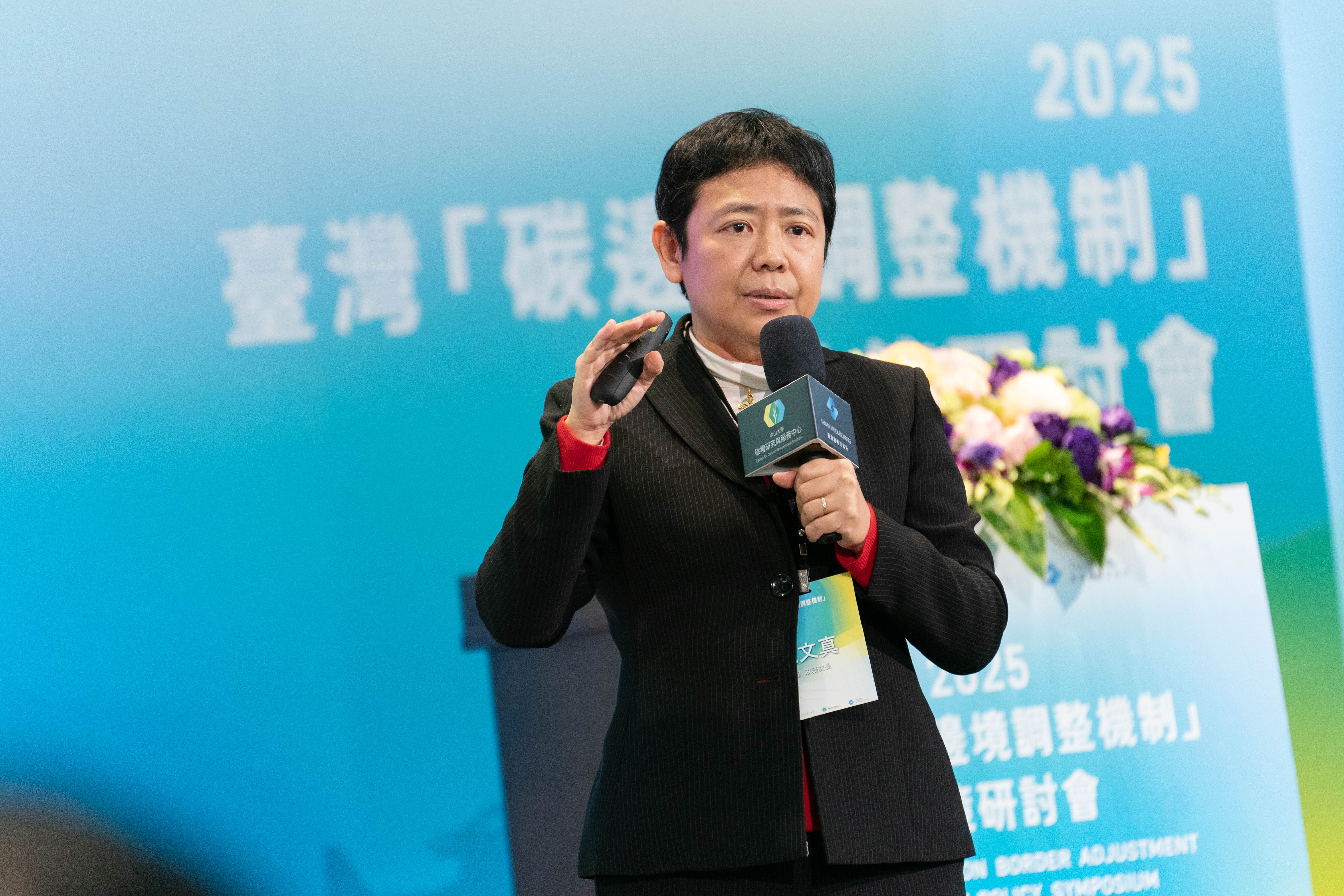
The seminar began with Wen-Chen Shih, Deputy Minister of the Environment, speaking as a professor of the Department of International Business at National Chengchi University, outlining the current status and key considerations of CBAM.
What is Carbon Border Adjustment Mechanism (CBAM)?
Wen-Chen Shih pointed out that nearly every government policy could potentially require the implementation of a border adjustment mechanism. “If domestic manufacturers incur additional costs due to certain regulations in the production process, we would naturally hope that imported products are subject to the same regulations. Some regulations are based on safety concerns, but if they are simply cost-increasing measures, we would apply ‘border adjustment’ mechanisms, only if there's such policy domestically,” she explained.
As climate change intensifies, carbon reduction has become a pressing issue that governments around the world must address, and industries are also being held accountable for reducing emissions. In this context, establishing fair and comprehensive mechanisms for international trade has become crucial, as a result formulating the Carbon Border Adjustment Mechanism (CBAM).
For example, the EU CBAM aims to effectively prevent carbon leakage by imposing certificate-related fees on imports of carbon-intensive products. During the transition phase, the initial scope of regulation covers six major industries: steel, cement, fertilizers, aluminum, electricity, and hydrogen; the list of covered products may expand over time. Wen-Chen Shih explained that CBAM is a tool designed to ensure fair competition between domestic and foreign industries by requiring imported goods to bear the same carbon cost as locally produced products. If the country of the imports has implemented a comparable carbon pricing mechanism, and it is recognized by the EU, the corresponding fees can be deducted.
CBAM may cause increases in the cost of products subject to the levy, thereby encouraging corporations to reduce carbon emissions during the manufacturing process. It is now gradually becoming an international trend.
From EU CBAM to TW CBAM
CBAM is a crucial policy tool for the EU, and it is one of the key measures proposed in the “Fit for 55” package, introduced following the European Green Deal that the European Commission announced in 2019, to ensure the achievement of the 2030 greenhouse gas reduction targets.
Wen-Chen Shih looked back at the legislative progress of climate policy in the EU. The EU has implemented a cap-and-trade system since 2005, initially targeting the aviation industry, which is regulated under WTO rules. Airlines flying to or departing from the EU were required to participate in the cap-and-trade regulation, but the resulting cost increases sparked significant backlash.
In the early stages, the EU aimed to reduce the carbon costs for industries at high risk of carbon leakage by setting a cap on emissions and offering free allowances as a form of preferential measure. However, since this is ultimately a carbon reduction tool, the EU hopes to accelerate the reduction of total emissions, and the goal is to eventually eliminate free allowances entirely and fully return to a cap-and-trade system, allowing the market to determine the carbon price.
In 2020, the President of the European Commission officially announced the CBAM, and a draft was released in 2021. By October 2023, the transitional reporting phase had begun, and by 2026, importers will be required to purchase CBAM certificates based on the carbon content of products entering the EU. (Note: In February 2025, the European Commission proposed to delay the start of CBAM certificate purchases until its full implementation in 2027.)1 However, the EU CBAM also allows deductions if the products have already been paid for an equivalent carbon pricing cost in the country of export.
When the EU announced the CBAM in 2020, it also had an impact on Taiwan, prompting the revision of the "Greenhouse Gas Reduction and Management Act" into the "Climate Change Response Act", incorporating the policy tool of carbon fees. The purpose of the revision was to align with the EU’s carbon pricing system and maintain Taiwan's competitiveness of international trade.
Wen-Chen Shih explained, “Nearly a quarter of global emissions are subject to carbon pricing, but that also means three-quarters are not. And even with the implementations of carbon pricing, the price varies from place to place. Under this context, it raises the question of whether a Taiwan version of CBAM is necessary.”
Complexity and disputes of CBAM
However, the definition of the carbon fee imposed on imported goods in Taiwan still requires clarification.
Obstacle 1: carbon tax vs. carbon fee, definition is unclearn
Wen-Chen Shih emphasized, “A carbon tariff refers specifically to imported products only and is based on the carbon content of those products.” Such a measure must comply with Article II of the General Agreement on Tariffs and Trade (GATT), which stipulates that once tariffs are negotiated between two countries, they cannot be raised unilaterally, thus becoming binding tariff rates.
Carbon fee is a type of border adjustment measure. To ensure fair trade, imported products are required to bear this cost only if there is a domestic carbon pricing mechanism in place. This reflects the principle of “national treatment” under Article III of the GATT. However, the prerequisite is that a carbon fee policy must first be established and implemented domestically.
Obstacle 2: How should carbon emission regulations be classified? As a direct tax or an indirect tax?
Cross-border products are categorized into direct and indirect taxes in terms of taxation:
- Direct taxes: typically refer to income tax or corporate income tax.
- Indirect taxes: levied on goods and services, with the tax burden passed on to the final purchaser or consumer, and reflected in the selling price.
Border adjustment measures only allow for the collection of indirect taxes. For example, energy fuels are considered subject to border adjustments as they fall under indirect taxes. However, Taiwan’s carbon tax is not levied on energy fuels but on emissions, and carbon emissions are not directly reflected in the final product. Take steel as an example, emissions from the steelmaking process are not embedded in the steel product itself. Even if two products are both steel, different production methods result in different levels of emissions. Therefore, emissions cannot be treated like raw materials for border adjustment purposes. As a result, whether carbon emissions can be considered a subject to indirect tax (and eligible for border adjustment) remains debatable.
However, if carbon fees cannot be applied through border adjustment measures (i.e. as an indirect tax), then they would be considered a tariff (a border measure), which is subject to much stricter regulations. The classification as either a tariff or non-tariff measure also determines the extent and intensity of legal regulations that apply.
Wen-Chen Shih pointed out, “If emissions are used as the basis for charging fees, does that make it a direct tax? That remains uncertain. If it is considered a direct tax, then border adjustment is not allowed; but if it is an indirect tax, then border adjustment is permitted, and you must comply with the principle of national treatment, which means you need to design a well-structured domestic system that aligns with fair trade principles.”
How to define and categorize carbon fees entirely depends on the design of the underlying public policy. However, Article XX of the GATT “General Exceptions” might offer a potential solution. The general exceptions allow for public policy justifications, such as measures necessary to protect the life or health of human, animal, or plant, or to conserve exhaustible natural resources. In such cases, the carbon fee would not be constrained by the definitions mentioned above.
The relevant definitions have not yet been finalized in Taiwan. Finally, Wen-Chen Shih emphasized, “When designing a border adjustment mechanism, it should align with the domestic system, as a symbol of fair trade. However, if the design fails to meet the principle of national treatment, it will become a trade barrier. Therefore, it depends on how Taiwan chooses to design CBAM if the country decides to implement such a mechanism.”
1 In the Omnibus proposal introduced by the European Commission in February 2025, the implementation of CBAM certificate charges is proposed to be postponed until 2027. To reduce the administrative burden on SMEs, a simplified amendment package was also introduced, including: exemption from obligations for small importers (mainly SMEs and individuals), exemption from CBAM reporting obligations for importers with annual imports of less than 50 tons, and simplified procedures for authorization of declarants, emissions calculations, and reporting compliance requirements. (Simplified and Enhanced CBAM Revision Proposal)
Based on the personal report on the "future of European competitiveness" presented by Mario Draghi, former President of the European Central Bank and one of the greatest economists in Europe, at the request of the European Commission, the Commission published the "Competitiveness Compass" in January 2025. The guide outlines three key measures and five strategies aimed at making the EU economy more prosperous and competitive. On February 26, the European Commission proposed two simplified "Omnibus packages" to create a more business-friendly environment and ensure that companies are not hindered by excessive regulatory burdens. These proposals are currently under review by the European Parliament and the Council of the European Union. The initial "Omnibus packages" consolidate proposals from several legislative areas and introduce broad simplification measures, including: sustainability report, corporate sustainability due diligence, the EU taxonomy for sustainable activities, CBAM, and the European investment framework.