
From Foundations to the Forward Paths: Japan and Korea Insights for Taiwan’s ETS Next Steps
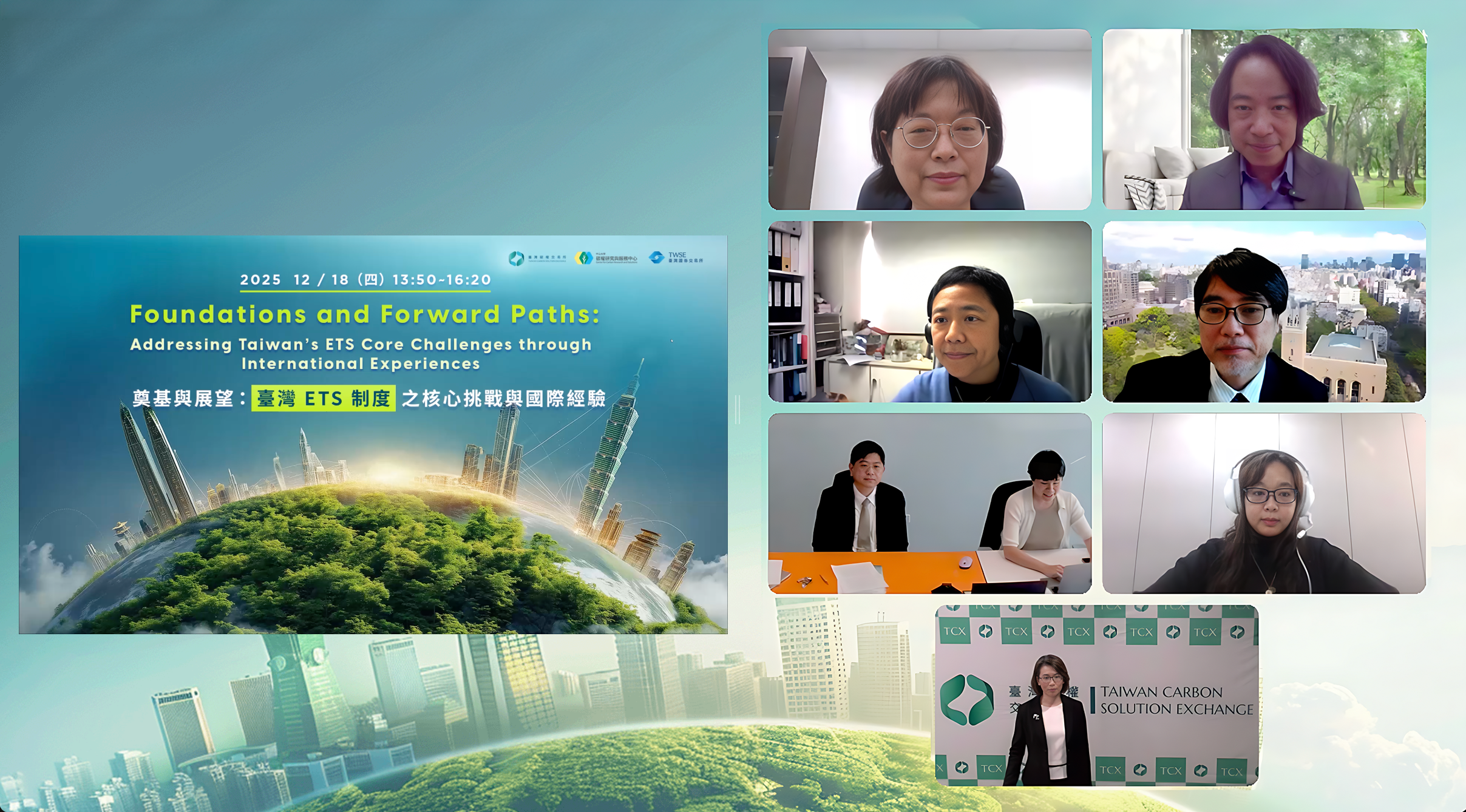 【Foundations and Forward Paths: Addressing Taiwan’s ETS Core Challenges through International Experiences】The online international symposium featured a cross-national dialogue among experts. From left to right: front row—Dr. Tsai Lin-Yi, Director-General of the Climate Change Administration, Ministry of Environment; Professor Wang You-Ren, Assistant Professor and Section Chief, CCRS, National Sun Yat-sen University. Second row—Professor Shih Wen-Chen, National Chengchi University, formal Deputy Minister of the MOENV; Professor Toshi H. Arimura, Waseda University. Third row—Professor Tsai Hung-Jeng, Director of the CCRS, National Sun Yat-sen University; Ms. Maureen Lee, Senior Researcher, Ecoeye. Fourth row— Ms. Seren Chen, CEO of the Taiwan Carbon Solution Exchange.
As global carbon pricing accelerates, Taiwan stands at a critical juncture—transitioning from a carbon fee system toward a cap-and-trade Emissions Trading System (ETS) and deeper international alignment. On December 19, the Taiwan Carbon Solution Exchange (TCX), Taiwan Stock Exchange (TWSE), and the Center for Carbon Research and Solutions (CCRS) at the National Sun Yat-sen University co-hosted the online international symposium “Foundations and Forward Paths: Addressing Taiwan’s ETS Core Challenges through International Experiences.” The event brought together carbon-pricing experts from Taiwan, Japan, and Korea to exchange East Asian ETS design and implementation experience and explore feasible pathways for Taiwan, attracting nearly 300 industry participants online.
In her opening remarks, Seren Chen, CEO of the Taiwan Carbon Solution Exchange, noted that the Ministry of Environment has announced the roadmap for Taiwan’s ETS (TW-ETS), with a simulated pilot planned for the second half of 2026. As a core market platform, the Exchange is strengthening market infrastructure to ensure stable and transparent operations. Drawing on international experience and deepening cross-border cooperation are expected to provide economic incentives for corporate transition while supporting the sustainable development of key sectors such as AI and green technologies.
Professor Tsai Hung-Jeng, Director of the CCRS at National Sun Yat-sen University, emphasized that an ETS offers clear emissions targets and implementation pathways. However, cap-setting must account for national industrial policy and overall economic development. He highlighted the strong similarities among Taiwan, Japan, and Korea in industrial structure and development trajectories, underscoring their high potential for mutual learning in carbon-pricing design and implementation.
Keynote Insights: From System Design to Practical Challenges
Tsai Lin-Yi, Director-General of the Climate Change Administration, Ministry of Environment (MOENV), outlined Taiwan’s ETS design priorities. Given the high share of manufacturing emissions, the system must balance climate ambition with industrial development. With the carbon fee taking effect in 2025 and collection beginning in 2026, Taiwan’s ETS will initially adopt voluntary participation and simulated operation to ensure smooth alignment, avoid regulatory overlap, and progressively complete the legal and market foundations before 2030.
Professor Toshi H. Arimura of Waseda University shared Japan’s GX-ETS experience, noting the early use of voluntary participation combined with a ¥20 trillion economic transformation bond to reduce industry resistance and build market foundations. As GX-ETS becomes mandatory nationwide in 2026, Japan will introduce measures such as price floors and ceilings to balance competitiveness with decarbonization incentives.
Maureen Lee, Senior Researcher at Ecoeye, reviewed a decade of Korea’s K-ETS development. Early phases suffered from weak price signals due to generous caps and high free allocation. In Phase IV (2026–2030), Korea plans to tighten the cap, increase auctioning, and introduce the K-MSR (Market Stability Reserve) to enhance market resilience and liquidity.
Professor Shih Wen-Chen of National Chengchi University, former Deputy Minister of the MOENV Taiwan, emphasized that a robust ETS rests on three pillars: environmental integrity, economic efficiency, and political acceptability. ETS elements are interlinked and must align with national legal frameworks, climate goals, and industrial characteristics to form a system suited to each country’s development needs.
Panel Discussion: Exploring Taiwan’s Next Steps
Moderated by Professor Wang You-Ren, Section Chief of the CCRS, the panel addressed how Taiwan can secure industry support and set appropriate caps during ETS development. Panelists agreed that pilot mechanisms and incentive design are essential to build corporate confidence and expectations. Japan’s bottom-up approach to GX-ETS consensus-building and Korea’s alignment of caps with its 2035 NDC offer valuable references. Designing and steadily advancing a phased ETS rollout emerged as Taiwan’s key next challenge.
Through cross-national exchange, the symposium provided important policy insights for Taiwan’s international carbon-pricing alignment. With the carbon fee now in place, Taiwan will progressively build a comprehensive carbon-pricing framework encompassing voluntary mitigation projects, cap-and-trade ETS, and the Carbon Border Adjustment Mechanism (CBAM). The TCX and the TWSE will continue to support national net-zero goals by fostering international dialogue and deepening industry collaboration—positioning Taiwan as a leading example of climate governance and carbon-market development in Asia.
🔗Source:Taiwan Carbon Solution Exchange